
If you have tinnitus and you have also started asking people to repeat themselves in meetings, at the dinner table, or in a restaurant, you are probably looking at hearing aids and wondering which one to buy.
The question underneath is whether any of them will do something about the ringing. Most buying guides skip that part. They compare battery life and Bluetooth and say nothing about what the device does for tinnitus.
This guide is written for the specific situation of choosing a hearing aid for tinnitus. It follows a fixed order, because the order matters: test first, then match the device to your hearing loss, your tinnitus, and your daily life.
I am a pharmacist, and I live with tinnitus, so I will also be direct about what hearing aids can and cannot do for the ringing.
Why I’m not starting with a product list
A list of the “best hearing aids for tinnitus” would be easy to write and not very useful to you.
The right device depends on the shape of your hearing loss, how your tinnitus behaves, and what your days demand of your ears. Two people with the same ringing can need completely different devices.
A list also pushes you to compare models before you know what you are comparing for. That is how people end up paying for features they never use while missing the one they needed.
So this article has no brand recommendations. It gives you a sequence to follow and the questions to ask at each stage. By the end, you should be able to walk into an audiologist’s office, or an online shop, and know what you are looking for.
Step one: get your hearing tested before you spend anything
Everything else depends on a proper hearing test, done by an audiologist or another qualified hearing professional.
Tinnitus often goes along with hearing loss, but you cannot tell from the ringing how much loss you have or at which pitches.
The test, called an audiogram, shows exactly that. It is also what any prescription hearing aid is programmed from.
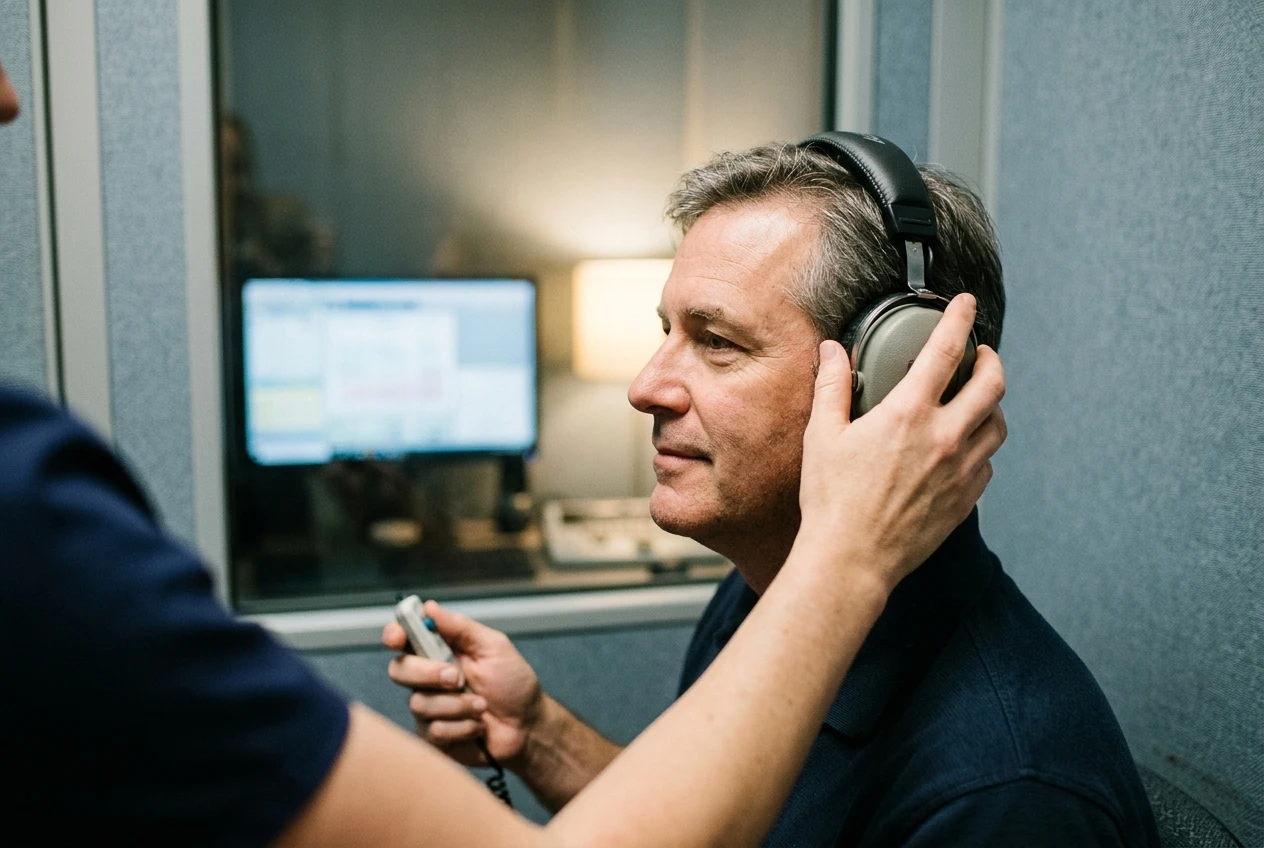
A few things worth knowing before you book:
- Ask for a full diagnostic test, not a quick screening in a shop. You want your hearing measured at each frequency in both ears, plus a speech-in-quiet test.
- Ask for a tinnitus assessment if the clinic offers one. This usually includes matching the pitch and loudness of your ringing and asking how much it affects your sleep, concentration and mood.
- Take a list of everything you take, including prescription medicines, over-the-counter painkillers and supplements. Some medicines are known to affect hearing or tinnitus, including high-dose aspirin, certain antibiotics and certain diuretics. Do not stop anything on your own. Tell the clinician and let them work out whether it matters in your case.
- Mention it if the ringing is in one ear only, if it pulses with your heartbeat, or if your hearing dropped suddenly. Those patterns need a medical review, not just a hearing aid.
The test also protects you financially. If your hearing is normal or close to it, you will have saved yourself the price of a device. If you do have a loss, you will have the numbers to compare devices against.
Will a hearing aid actually help my tinnitus? What the evidence supports and what it doesn’t
This is the question most people really want answered, so here is the plain version.
Hearing aids do not cure tinnitus, and no hearing aid removes it permanently. What they can do is make it less prominent.
When hearing loss is present, the brain receives less outside sound, and tinnitus often becomes more noticeable against that quiet. A hearing aid brings everyday sounds back up, such as voices, the fridge, traffic, and footsteps. Many people find the ringing then sits further in the background.
Clinical guidance for tinnitus supports this reasoning. It recommends a hearing assessment for people with persistent tinnitus, and a hearing aid evaluation when hearing loss is found. The research behind it is mixed in quality, and results vary a lot between people. Some people notice a clear improvement, some a small one, and some none at all.
What the evidence does not support is any device or ad promising to “eliminate” or “reverse” tinnitus. If a product claims that, treat it like a supplement with a miracle claim on the label.
The second thing a hearing aid does is help with the part of tinnitus that wears people out: straining to follow conversations. Less strain means less fatigue, and fatigue and stress both make tinnitus feel louder. That is a real benefit even when the ringing itself changes very little.
If your tinnitus is making you anxious or low, a hearing aid alone will not be enough. I cover that side in how to manage your mental health with tinnitus.
Tinnitus features worth paying for, and the ones that are just marketing
Once you know your hearing loss, you can look at features. Here is how I would sort them.
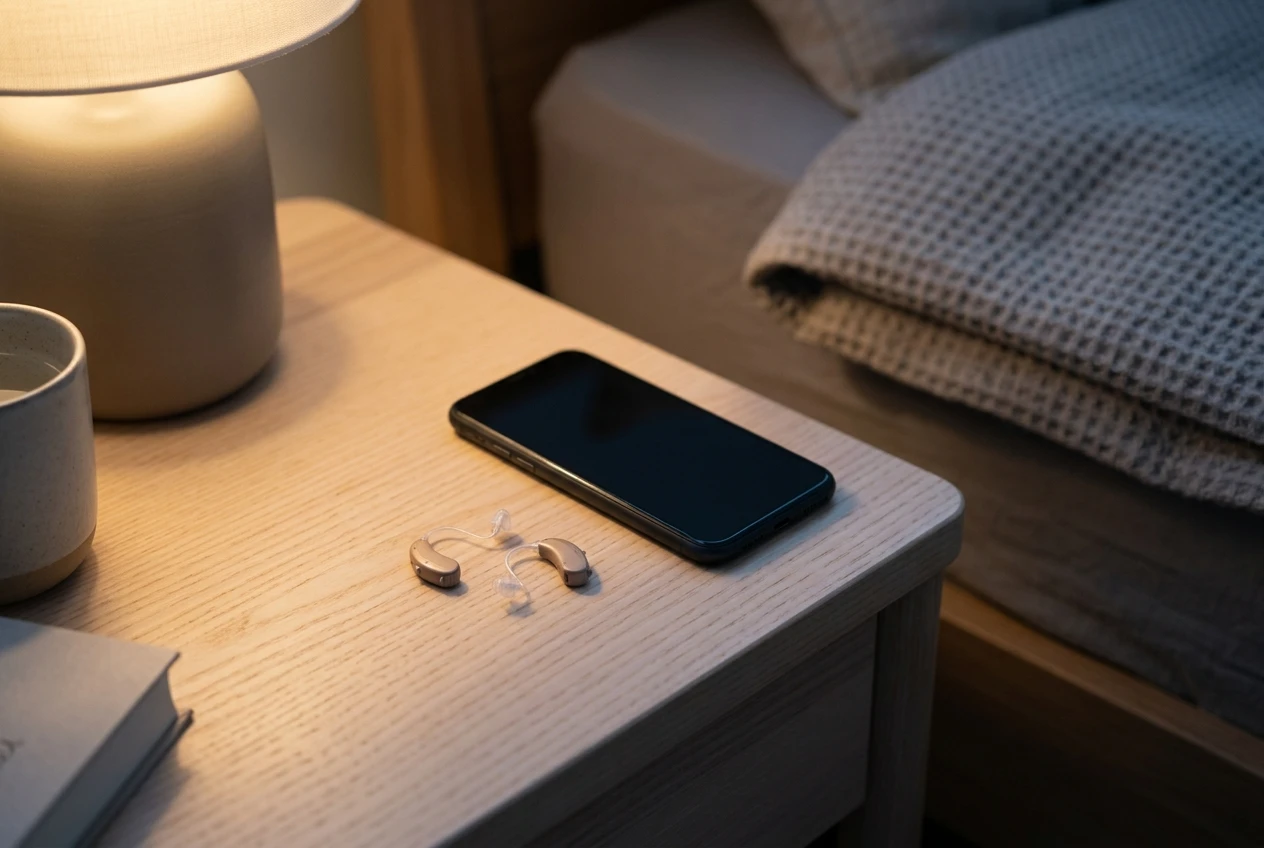
Worth paying for
- Built-in sound therapy. Many hearing aids can play a soft masking sound, such as white noise, nature sounds or tones that change slowly, directly into your ears. It is useful at night or in a quiet room, when the ringing is at its worst. Check that you can adjust the volume and switch it on and off yourself, and that you can choose between different sounds, since people respond differently.
- Smartphone streaming. If a device can stream audio from your phone, you can play any masking track or app you already like. This gives you more variety than a built-in sound library.
- An open or vented fit, where your hearing allows it. Fully blocking the ear canal can make your own voice sound boomy and sometimes makes tinnitus seem louder. If your loss is mild to moderate at high pitches, an open fit often feels more natural. Your audiologist can tell you whether it works with your audiogram.
- Rechargeable batteries, if you want fewer small things to handle. This is a convenience feature, but it is one you will notice daily.
Often just marketing
- “Tinnitus cure” or “tinnitus relief” claims on the box. Look for what the device actually does: masking sound, amplification, or both.
- Impressive-sounding AI or “smart” labels. Ask what the feature does in a noisy room, and whether you can try it.
- Channel counts quoted as a sign of quality. More channels give a clinician finer control, but the quality of the fitting matters more than the number on the box.
- Premium tiers you will not use. If you never take calls through your hearing aids, a model built around that feature is wasted money.
If you notice that everyday sounds feel too loud or painful, tell your audiologist before choosing anything. That points toward a different problem, covered in what tinnitus and hyperacusis are and how they differ, and it changes how a device should be set up.
Match the device to your real day: meetings, the school run, restaurants, quiet nights
Now put your own life next to the feature list. Write down the five situations where you struggle most and what each one needs from a device.
- Meetings and video calls. You need clear speech at a distance and, ideally, direct streaming from your laptop or phone so the voices come straight into your ears. Ask how the device performs with several people talking.
- The school run and time with your kids. Children’s voices are high-pitched and often soft. If your loss is in the high frequencies, those are exactly the sounds you miss. Ask for your audiogram to be compared with the range of a child’s speech, and have the clinician demonstrate with a recording.
- Restaurants and family gatherings. This is where most people are disappointed. Hearing aids help, but background noise is hard for every device. Look for directional microphones, which focus on the person in front of you, and ask whether the device has a setting you can switch for noisy places. Ask to try it in a real noisy environment, not just the quiet consulting room.
- Quiet nights. This is where tinnitus is usually loudest. Decide whether you want to sleep with a masking sound from a bedside speaker or pillow speaker instead, which does not require wearing the hearing aids in bed. Many people use separate sound devices at night and keep the hearing aids for the day.
- Work that involves noise or movement. If you are on a site, in a workshop or on the road, check dust and moisture resistance, and how the device stays in place when you move around.
Bring this list to your appointment. A good audiologist will use it to narrow the options rather than starting from whatever they stock.

Prescription, over-the-counter or online: what you give up and gain with each
There are three main routes, and each has trade-offs.
Prescription devices from an audiologist. You get a full test, a device programmed to your audiogram, fitting adjustments, and follow-up visits. The cost is usually the highest, and some clinics bundle service into the price while others charge for it separately. Ask which applies.
This is the route I would suggest when you have tinnitus on top of hearing loss, because the tinnitus settings are best set by someone who can hear what you are describing.
Over-the-counter hearing aids. In the United States, the FDA created an over-the-counter category in 2022 for adults with perceived mild to moderate hearing loss.
These cost less, and you can buy them without an appointment. What you give up is the individual programming and the in-person adjustment. They are designed for mild to moderate loss, so they are not suitable if your loss is greater or if you have a sudden or one-sided change. Rules differ in other countries, so check what applies where you live.
Online-only purchases and direct-to-consumer brands. Some send you a kit, some ask you to upload a hearing test, and some offer remote adjustments. The convenience is real.
The risk is that nobody checks your ears physically, and that you may have no one local to turn to if the fit is wrong. Look closely at what remote support is included.
Whichever route you take, get a test first, and check the return policy before you pay.
Fit, trial periods and follow-up: how to avoid an expensive mistake
Most disappointment with hearing aids comes from fit and settings, not from the device itself.
A device that is too loud, too tight, or poorly programmed will feel like a failure when it only needs adjusting.

Before you commit, get these answers in writing:
- How long is the trial period, and what is the return process if you decide to return the devices? Are any fees non-refundable?
- How many follow-up appointments are included, and what do extra ones cost?
- Who can adjust the tinnitus sound settings, and can you change them yourself through an app?
- What does the warranty cover, including loss and damage, and for how long?
- What happens if your hearing changes? Can the devices be reprogrammed?
Give yourself time to adjust. Your brain needs days to weeks to get used to hearing sounds it has been missing. Wear them for a few hours a day at first and build up. Keep a short note of how the ringing feels at different times of day and in different places, and take it to your follow-up. That gives the audiologist something concrete to adjust.
If the ringing feels worse after the first couple of weeks, do not just put up with it. Go back and say so. It is often a volume or fit setting that can be changed.
Questions to take to your audiologist, and what to do this week
Print or save this list and take it with you:
- Based on my audiogram, how much of my difficulty is hearing loss and how much could be something else?
- Is my tinnitus likely to improve with amplification, with masking, or with both?
- Which devices would you suggest for my loss, and why those over the others?
- Does the device have built-in sound therapy, and can I control it myself?
- Would an open fit work for me, and what are the downsides?
- How will it perform in meetings, in a noisy restaurant and when my children speak?
- What is the trial period, and what does it cost if I return them?
- What follow-up is included, and how do I reach you if something feels wrong?
- Do any of my current medicines affect hearing or tinnitus?
What to do this week:
- Book a full hearing test with an audiologist, and mention your tinnitus when you book.
- Write down your five hardest listening situations, from your own week.
- Make a list of your medicines and supplements to bring with you.
- Hold off on buying a device until you have your audiogram in hand.
That order of events costs you very little and puts you in a much better position to choose well. If your results come back and you are unsure what they mean, bring them to your audiologist with the questions above, and ask for the answers in plain language.
That is the whole process, and I know it is a lot to take in. Get tested first, match the device to the days you actually live, and do not let anyone rush you into a purchase.
I wish you good luck with your search. I am here for you too, so if you have questions as you go, feel free to ask me and I will do my best to answer.
If you want to keep reading, there are more articles on tinnitus at dealwithtinnitus.com. I do not have an email list or a course for sale yet, so for now my aim is simply to give you free, honest information you can use.